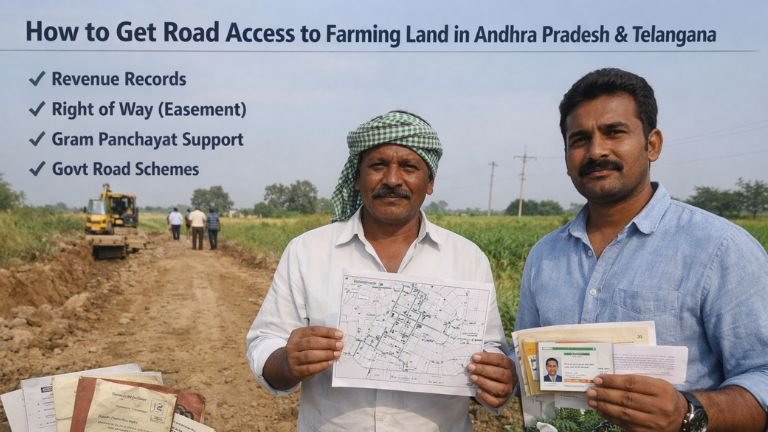
Road : How to Get Road Access to Farming Land in Andhra Pradesh & Telangana
Lack of proper road access to agricultural land is one of the most serious problems faced by farmers in both Andhra Pradesh and Telangana. Thousands of farmers own fertile land but struggle to reach it due to blocked paths, private land barriers, or missing revenue roads. This issue often results in:
-
Disputes with neighboring landowners
-
Long-pending court cases
-
Difficulty transporting crops and machinery
-
Reduced land value
-
Lower productivity
However, farmers are not helpless. Both states provide strong legal and administrative remedies to obtain lawful road access (approach road / farm road).
This complete guide explains every possible solution — revenue methods, easement rights, panchayat intervention, government schemes, and court options.
What Is a “Landlocked” Agricultural Land?
A farming land is considered landlocked when:
-
There is no direct access to a public road
-
Entry is blocked by surrounding private lands
-
Traditional village pathways are encroached
-
Revenue roads exist in records but not on ground
In such situations, the landowner has a legal right of access, even if neighbors object.
Legal Right to Road Access in India
Indian law protects farmers from being denied access to their land. Key legal support comes from:
-
Indian Easements Act, 1882
-
State Revenue Laws of Andhra Pradesh & Telangana
-
Civil Court Jurisdiction
-
Rural Infrastructure Development Policies
Even if the land is surrounded by private property, the law allows creation of a minimum necessary access road.
Method 1: Road Access Through Revenue Records (Most Common & Effective)
What Is a Revenue Road?
A revenue road is a pathway recorded in official land records such as:
-
Field Measurement Book (FMB)
-
Village Map / Tippan
-
Adangal / Pahani
-
Sethwar / RSR
Sometimes these roads disappear physically due to encroachments but remain legally valid.
Step-by-Step Process
Step 1: Visit Village Revenue Office / Secretariat
Request certified copies of village map and FMB.
Step 2: Check for Existing Path
Look for terms like:
-
Daari
-
Bata
-
Road
-
Poramboke
Step 3: Submit Written Application
Apply to the Tahsildar / Mandal Revenue Officer (MRO).
Step 4: Official Survey
Revenue surveyor inspects and demarcates the road.
Step 5: Removal of Encroachment
If road exists in records, officials can legally restore it.
⏳ Time Required: 1–3 months (in most cases)
This is the simplest and fastest solution.
Method 2: Applying for Right of Way (Easement Right)
If no road exists in revenue records, farmers can claim a Right of Way under law.
Legal Basis
Sections 13 & 14 of the Indian Easements Act, 1882 allow landowners to seek access when land is completely blocked.
When Can You Apply?
-
Land is fully surrounded by other properties
-
No alternate access exists
-
Access is essential for cultivation
Procedure
-
Submit application to Revenue Divisional Officer (RDO)
-
Attach:
-
Sale deed
-
RTC / Pahani
-
Village map
-
Affidavit explaining hardship
-
-
Officials inspect and identify shortest feasible route
-
Compensation may be fixed (if neighbor land affected)
-
Road width typically fixed between 10–20 feet
⏳ Time Required: 3–6 months
This method ensures lawful permanent access.
Method 3: Gram Panchayat & Local Body Intervention
Village panchayats have authority to:
-
Protect common village paths
-
Recommend new agricultural roads
-
Pass resolutions for rural connectivity
How to Use This Option
-
Submit written application to Gram Panchayat
-
Panchayat passes resolution
-
Proposal forwarded to Mandal / District officials
-
Road included under rural development works
⏳ Time Required: 6–12 months
This option works well when multiple farmers need access.
Method 4: Government Farm Road Schemes
Both states implement rural road connectivity programs under:
-
Rural Development Departments
-
Agriculture Infrastructure Programs
-
SC/ST farmer welfare schemes
Features
-
Roads connecting farms to main roads
-
Priority to small & marginal farmers
-
Government-funded or partially funded
-
Implemented through approved contractors
Farmers should regularly check:
-
District Collector notices
-
Mandal Panchayat office
-
Agriculture department announcements
Method 5: Filing a Civil Case (Last Option)
If revenue and administrative methods fail, farmers can approach Civil Court.
Types of Cases
-
Suit for Right of Way
-
Easement declaration
-
Permanent injunction against obstruction
Court Powers
-
Order creation of access road
-
Remove illegal blockages
-
Award compensation
⏳ Time Required: 1–3 years
Courts generally support farmers if access is genuinely necessary.
Documents Required (Common for All Methods)
Keep these ready:
-
Sale deed / Patta
-
RTC / Pahani / Adangal
-
Village map & FMB copy
-
Aadhaar card
-
Photographs of blocked access
-
Neighbor details (if dispute exists)
-
Affidavit explaining issue
Proper documentation increases success rate.
Telangana-Specific Practical Approach
In Telangana:
-
Digital land records available through Dharani Portal
-
RDO plays a key role in dispute resolution
-
Revenue officers actively restore recorded roads
-
Official survey is crucial
Farmers should avoid informal negotiations and insist on written applications.
Citizen services are available through MeeSeva Telangana.

Andhra Pradesh-Specific Practical Approach
In Andhra Pradesh:
-
Village Secretariat is first contact point
-
Field Measurement Book (FMB) is key evidence
-
Panchayat system is strong for rural road proposals
-
Revenue inspections are commonly ordered
Land administration services are handled by the Revenue Department of Andhra Pradesh.
Common Mistakes Farmers Should Avoid
- Using force to open road
- Paying bribes instead of filing official request
- Relying only on verbal permissions
- Ignoring official surveys
- Delaying legal action
Always follow written legal procedures.
Approximate Time Comparison
| Method | Estimated Time |
|---|---|
| Revenue road restoration | 1–3 months |
| Easement right approval | 3–6 months |
| Panchayat rural road | 6–12 months |
| Civil court case | 1–3 years |
Final Advice for Farmers
Farmers in Andhra Pradesh and Telangana have strong legal rights to access their agricultural land. No land should remain permanently inaccessible.
The key to solving road access issues is:
-
Proper documentation
-
Written official applications
-
Requesting government survey
-
Patience with procedure
Whether through revenue records, easement rights, panchayat support, or court action, permanent legal solutions are available.
By following the correct administrative path, farm road disputes can be resolved lawfully and permanently — ensuring smooth cultivation, better productivity, and increased land value for generations to come.